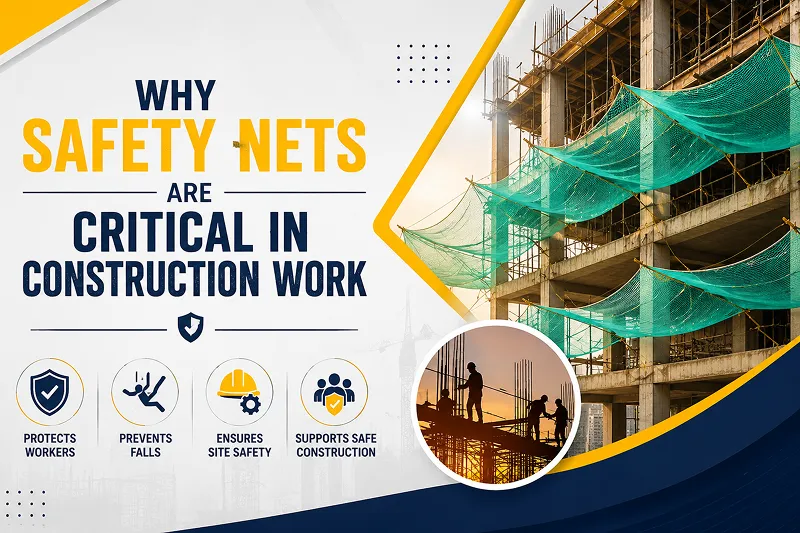
Why Safety Nets Are Important in Construction Work
Walk past any mid-rise building site in Gujarat and you'll notice something: the good contractors have nets up before the second floor is even poured. The sloppy ones add them later, usually after someone's had a scare.
That's the honest starting point for talking about safety nets construction applications: they're not decoration, and they're not a formality for the inspector's clipboard. They're the one thing standing between a fall and a fatality when a worker is thirty feet up with nothing but scaffolding under his boots.
What actually happens without them?
Falls from height account for a huge share of construction site injuries in India, and most of them aren't dramatic collapses—they're a missed step, a loose plank, a gust of wind at the wrong moment. A harness helps, but harnesses fail when anchor points are wrong or workers unclip too early to move faster. Nets don't rely on the worker doing everything right. They catch mistakes, which is the whole point of a fall-arrest system in the first place.
Where nets get used on a real site
- Perimeter netting around the building edge, so nothing—tools, debris, or a person—goes past the structure and down to the street.
- Debris netting to stop loose material from raining down on workers or pedestrians below.
- Fall-arrest netting slung beneath working platforms on multi-storey builds, positioned to catch a fall before it becomes a long one.
- Facade and scaffold netting, which doubles up as dust control on renovation and demolition jobs.
I'd argue debris netting gets underrated. Everyone thinks about falls, fewer people think about the loose bolt or brick chip that drops six floors onto someone walking below. Both problems need the same material, just positioned differently.
Why the material itself matters
Not every net on the market is built for this job. Cheap polyethylene tears in monsoon winds and degrades fast under direct sun—which, if you've worked a Gujarat summer, you know is brutal on any exposed material. HDPE monofilament netting holds up better: UV-stabilized yarn, tighter mesh consistency, and enough tensile strength to actually arrest a fall instead of stretching past its limit and letting the load through anyway.
This is where a lot of site accidents trace back to procurement shortcuts, not to bad luck. A net that looks fine in the packaging can still be undersized for the load it needs to hold, or made from yarn that's already brittle after six months outdoors.
The compliance angle
Beyond the human cost, most state labour departments and BOCW (Building and Other Construction Workers) regulations now expect documented fall-protection measures on any site above a certain height. Auditors check for it. Insurance claims get contested without it. So there's a paperwork reason to get this right too, even if the safety reason should be enough on its own.
Getting the right net for the job
Different builds need different mesh density, breaking strength, and mounting setups—a residential tower isn't rigged the same way as an industrial shed or a bridge retrofit. Majestic Nets manufactures HDPE monofilament netting built specifically for construction site applications, with the UV resistance and tensile strength to hold up through a full project timeline, not just the first few months. You can check specifications and get a quote at majesticnets.com.
Frequently Asked Questions