Shade Net House Materials
Ask any capsicum or rose grower who's used a cheap shade net for a full season, and you'll get some version of the same story. First few months, it looks fine. Then the mesh starts sagging in the middle, one corner tears loose in a storm, and suddenly the "50% shade" net is behaving more like 30% in some patches and 60% in others. Nobody told the crop the net was cheap, but the crop knows anyway.
That's really what this comes down to. A shade net house isn't just a roof that blocks sun — it's controlling the whole microclimate underneath: light, heat, air movement, humidity. Get the material wrong and you're not shading the crop properly, you're just filtering light unevenly while heat still builds up below.
The label doesn't tell you the whole story
Two nets can carry the exact same shade percentage on the packaging and behave completely differently by month eight. I've seen this play out with farmers who bought the cheapest option twice in three years, because it kept failing early, before switching to something better and getting five years out of one net instead.
So what actually separates a net that holds up from one that doesn't?
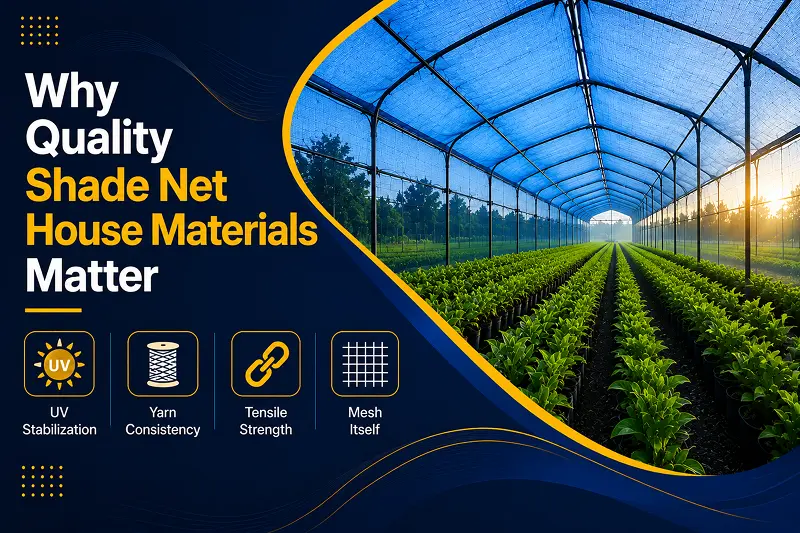
UV stabilization is probably the biggest one, and it's also the easiest thing for a seller to fudge. Raw HDPE breaks down fast under constant sun unless the stabilizer is mixed into the yarn during extrusion. Some cheaper nets get a surface coating instead, which looks the same on day one and wears off within a season. You genuinely can't tell the difference by looking at it in a shop — you have to ask how it was made.
Then there's yarn consistency. If the monofilament isn't woven to a uniform gauge, you get patchy shading — thicker in some spots, thinner in others — and that shows up as visibly uneven growth across the same bed. It's subtle at first. By month four it's obvious which rows got more light.
Tensile strength matters more than people think too, mostly because net houses cover a large surface area and catch real wind load. A net that stretches or gives way in a storm doesn't just need replacing — it comes down on whatever's growing underneath it.
And then there's the mesh itself. A net that starts unraveling at the edges doesn't stay a small problem. It spreads inward, and what should've been a five-year net turns into an eighteen-month net.
What I'd actually ask before buying
GSM and shade percentage are the easy questions — any seller can answer those. The one that actually separates a serious supplier from someone reselling stock is: how is the UV stabilization done, and can they show you test data on it? If the answer is vague, that's the answer.
Worth the extra scrutiny
If a net house is protecting real income — a nursery, a flower crop, a polyhouse running on tight margins — the material holding it together deserves the same attention people already give the irrigation system or the structure itself. It's usually the cheapest-looking part of the budget and the easiest thing to cut corners on, which is exactly why it's worth not doing that.
Majestic Nets makes HDPE monofilament shade net material for horticulture and net house use, with UV stabilization built into the extrusion process rather than added as a coating. If you want actual specs before deciding, majesticnets.com has the product details.
Frequently Asked Questions